ANNA NEXUS LABS LLC / OPE3.27N NEURAL FORGE
ANNA Neural Intelligence
ANNA Neural Intelligence is a hardware-aware neural-network engineering project developed by Anna Nexus Labs LLC. It explores neural-network training, inference performance, optimization, quantization, and the relationship between machine-learning architectures and computing hardware.
Locally trained and CPU measured. Evidence recorded October 13, 2026. Owner approved public release on October 13, 2026. Complete source and measured evidence are publicly available on GitHub. The source was developed with AI assistance and tested locally.
A trained network alongside ANNA
ForgeCNN is an original, standalone PyTorch convolutional model trained from random weights on UCI Optical Digits. ANNA 1.3 remains the separate multi-agent orchestration system. Its live provider experiment is unapproved, with $0 authorized spending. Connecting this classifier to ANNA is future work.
Model architecture
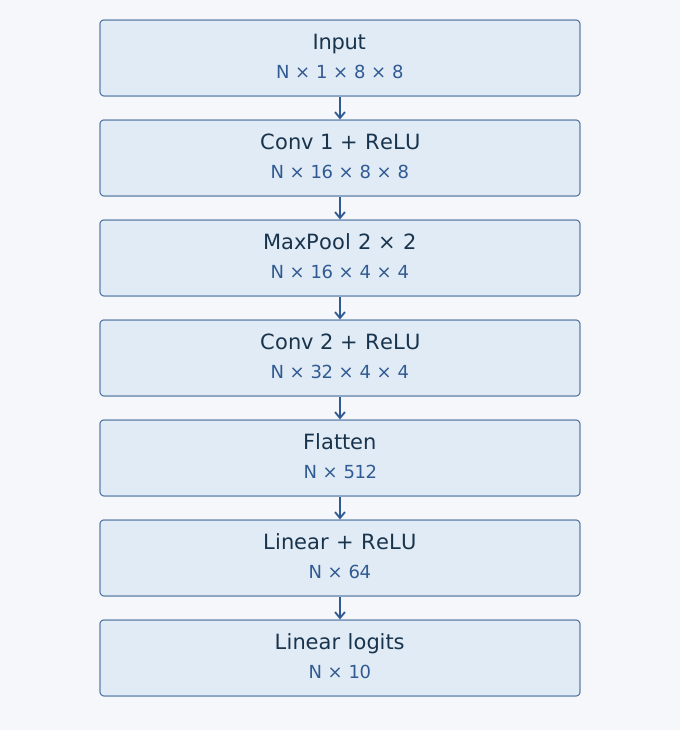
38,282 trainable parameters. Two convolutions with ReLU, one pooling layer and a 64-unit classification head produce ten logits. Estimated convolution and linear work: 116,352 multiply-accumulates per image, excluding other operations.
Training and held-out evaluation
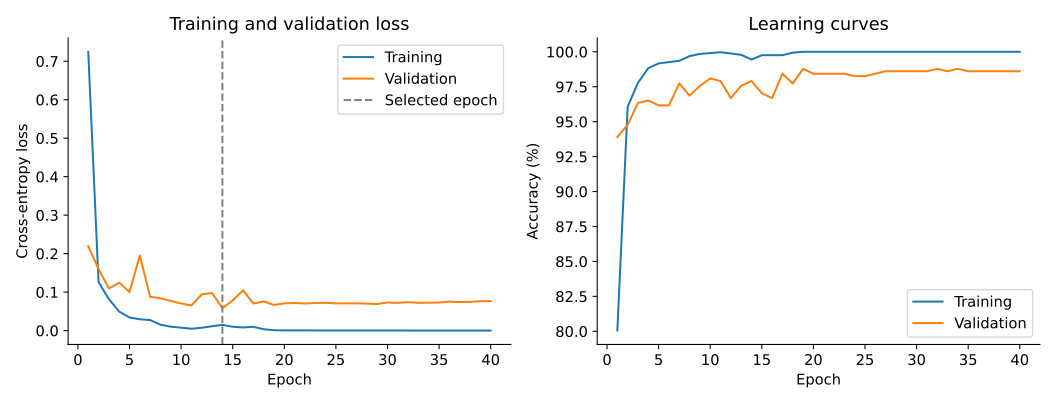
3,249 training images, 574 validation images and an official test file with 1,797 images. Normalization fits only training data. AdamW trains for 40 fixed epochs with batch size 64 and learning rate 0.002. The reference checkpoint minimizes validation loss at epoch 14. Test data does not select weights or training settings.
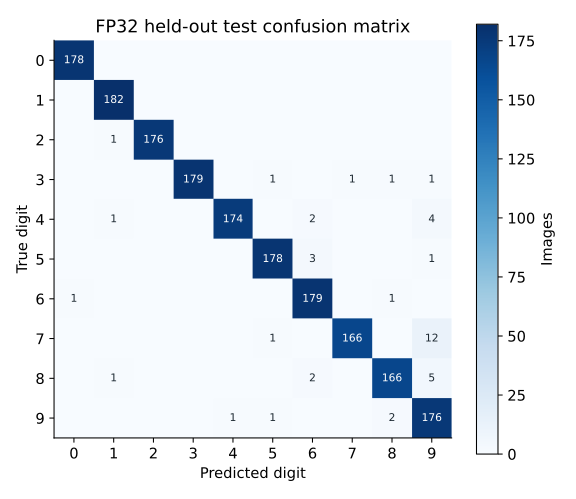
Three fixed seeds achieved 97.61%, 97.33% and 97.38% test accuracy. The predefined reference seed is 369. Repeating it reproduced identical selected weights and test metrics in this CPU environment.
Precision and storage tradeoffs
| Variant | Accuracy | State size |
|---|---|---|
| FP32 | 97.61% | 156,412 bytes |
| FP32 channels-last | 97.61% | Same logical weights |
| INT8 x86 | 96.72% | 47,854 bytes |
INT8 calibration uses 512 training images. The quantized state is 3.27 times smaller, but accuracy drops by 0.89 percentage points. Serialized state excludes the optimizer and runtime. INT8 checkpoint reload reproduced identical logits locally.
Measured CPU inference
Xeon Platinum 8573C CPU in a shared Linux container, eight-core quota and an 8 GiB memory limit. PyTorch 2.5.1 CPU with Python 3.12. No GPU or custom Tesla hardware was available.
36 measured conditions compare FP32, channels-last FP32 and INT8 at batches 1, 8, 32 and 128 with 1, 2 and 4 intra-op threads. Each condition uses 30 warmups and five repetitions of 100 timed forwards. Preallocated synthetic input is used for timing; real held-out data is used for accuracy.
| Variant | Batch | Median ms | p95 ms | Images/s |
|---|---|---|---|---|
| fp32 | 1 | 0.0660 | 0.3932 | 7,764 |
| int8 | 1 | 0.2695 | 0.9936 | 2,606 |
| fp32_channels_last | 1 | 0.0553 | 0.2499 | 11,301 |
| fp32 | 8 | 0.2724 | 0.9089 | 21,430 |
| int8 | 8 | 0.2818 | 0.8078 | 20,902 |
| fp32_channels_last | 8 | 0.1769 | 0.5172 | 33,142 |
| fp32 | 32 | 1.4586 | 3.2477 | 17,786 |
| int8 | 32 | 0.3714 | 0.8605 | 72,989 |
| fp32_channels_last | 32 | 0.3507 | 1.0294 | 69,056 |
| fp32 | 128 | 2.0358 | 2.7771 | 60,340 |
| int8 | 128 | 0.9667 | 1.6921 | 121,799 |
| fp32_channels_last | 128 | 1.0718 | 1.9190 | 107,984 |
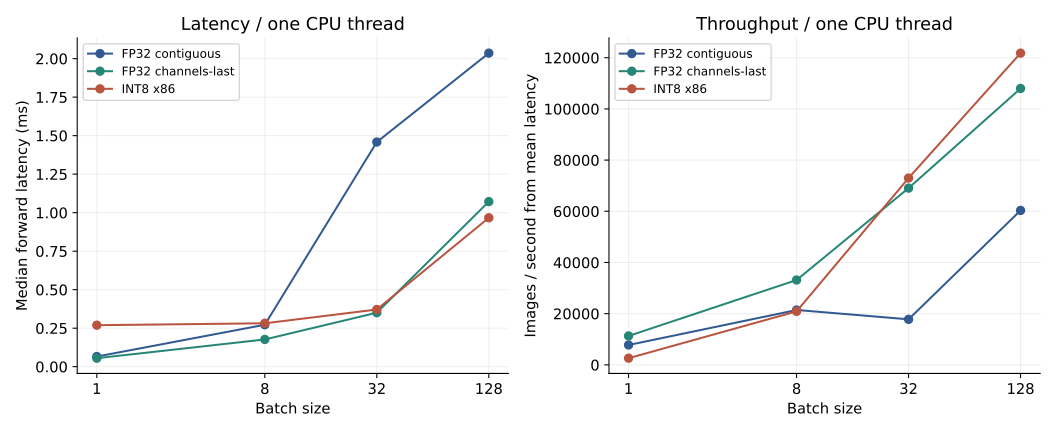
INT8 is slower at batch one and faster than contiguous FP32 at larger one-thread batches in these observations. Channels-last also improves several conditions. Shared-host timing variability limits performance conclusions. These ratios do not transfer automatically to another platform.
Verification and limitations
- Locally verified: 29 neural tests, full training, checkpoint restoration, held-out metrics, quantization, CPU benchmarks and profiles.
- Simulated: only ANNA's separate retained orchestration simulations; neural training results here are real local measurements.
- Planned: larger datasets, additional hardware and separately reviewed ANNA integration.
- Unmeasured: GPU and Tesla accelerator performance, energy, sustainable memory bandwidth and production behavior.
- Public release: owner authorized. These are locally measured CPU results; external reproduction remains open. No employer endorsement or certification is claimed.
Process peak RSS includes Python and PyTorch; it is not isolated activation memory. First-forward timing differs from full process startup. Strict FP32 training stays enabled, while INT8 inference has a scoped deterministic-enforcement exception for a pinned PyTorch kernel limitation.
Reproduce and inspect
Engineering report · Layer specifications · Benchmark methodology · Dataset and license · Complete benchmark CSV · Measurement summary JSON
GitHub repository: Christopher4U1978/anna-neural-intelligence. Source, raw samples, model checkpoints and demonstration materials are in the review package. No placeholder repository URL is presented.
python -m unittest discover -s tests -v
python -m anna_neural.cli train --out checkpoints/my-run
The UCI dataset has a CC BY 4.0 license. Alpaydin and Kaynak, Optical Recognition of Handwritten Digits (1998). Small digit classification does not establish production vision performance.